AI and the Future of Work
History offers a useful lens: what does the track record of transformative technologies and productivity growth actually reveal about their impact on employment?
There has been much talk recently about the large productivity gains artificial intelligence (AI) could help to generate. Some believe these productivity gains will enable companies to significantly reduce their workforce, creating fears of high unemployment and resulting economic weakness. What can history tell us about how technology and productivity have impacted employment?
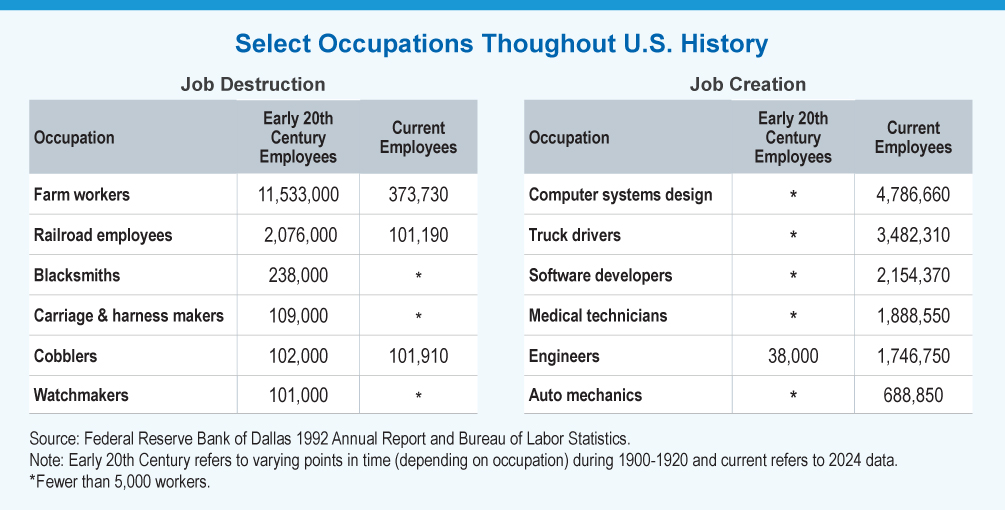
- In the late 19th century, the invention of the tractor led to a significant increase in agricultural productivity. This resulted in fewer farm-related jobs, and displaced workers moved to cities and found work in manufacturing. A similar shift took place as productivity and globalization later impacted the manufacturing sector and Americans gravitated to service jobs, which now represent roughly two-thirds of U.S. employment. This dynamic reflects what economist Joseph Schumpeter called “creative destruction”—the continual dismantling of old economic structures and their replacement with new, more productive ones. Critically, value and labor were not destroyed at each transition; they were reallocated (see also
AI is an Investment Opportunity, Not an Economic Catastrophe).
- More than 60% of today’s jobs did not exist prior to World War II.1 In the table above, the left segment (Job Destruction) shows that many popular occupations in the early 20th century, such as blacksmiths, carriage & harness makers, cobblers, and watchmakers, have largely disappeared. Conversely, the right segment (Job Creation) shows that entirely new occupations now employ millions of Americans, including computer systems designers, software developers, truck drivers, medical technicians, and auto mechanics.
- In our view, prior waves of technological change suggest AI will likely render certain jobs obsolete. In the near-term, AI disruption may favor capital over labor, underscoring the potential investment opportunity in AI enablers driving the massive buildout of data center infrastructure. Over the long-term, history has consistently shown that technological innovation creates new roles that were impossible to predict in advance. Just as the internet gave rise to e-commerce, cloud computing, and social media, we believe AI may follow a similar path, creating new industries and jobs that are difficult to envision today.
1Autor, David. 2022. The Labor Market Impacts of Technological Change: From Unbridled Enthusiasm to Qualified Optimism to Vast Uncertainty. NBER Working Paper No. 30074. Cambridge, MA: National Bureau of Economic Research.
The views expressed are the views of Fred Alger Management, LLC (“FAM”) and its affiliates as of April 2026. These views are subject to change at any time and may not represent the views of all portfolio management teams. These views should not be interpreted as a guarantee of the future performance of the markets, any security or any funds managed by FAM. These views are not meant to provide investment advice and should not be considered a recommendation to purchase or sell securities.
Risk Disclosures: Investing in the stock market involves risks, including the potential loss of principal. Growth stocks may be more volatile than other stocks as their prices tend to be higher in relation to their companies’ earnings and may be more sensitive to market, political, and economic developments. Past performance is not indicative of future performance. Investors whose reference currency differs from that in which the underlying assets are invested may be subject to exchange rate movements that alter the value of their investments. Companies involved in, or exposed to, AI-related businesses may have limited product lines, markets, financial resources or personnel as they face intense competition and potentially rapid product obsolescence, and many depend significantly on retaining and growing their consumer base. These companies may be substantially exposed to the market and business risks of other industries or sectors, and may be adversely affected by negative developments impacting those companies, industries or sectors, as well as by loss or impairment of intellectual property rights or misappropriation of their technology. Companies that utilize AI could face reputational harm, competitive harm, and legal liability, and/or an adverse effect on business operations as content, analyses, or recommendations that AI applications produce may be deficient, inaccurate, biased, misleading or incomplete, may lead to errors, and may be used in negligent or criminal ways. AI technology could face increasing regulatory scrutiny in the future, which may limit the development of this technology and impede the future growth. AI companies, especially smaller companies, tend to be more volatile than companies that do not rely heavily on technology.
Important Information for US Investors: This material must be accompanied by the most recent fund fact sheet(s) if used in connection with the sale of mutual fund and ETF shares. Fred Alger & Company, LLC serves as distributor of the Alger mutual funds and ETFs.
Important Information for UK and EU Investors: This material is directed at investment professionals and qualified investors (as defined by MiFID/FCA regulations). It is for information purposes only and has been prepared and is made available for the benefit investors. This material does not constitute an offer or solicitation to any person in any jurisdiction in which it is not authorized or permitted, or to anyone who would be an unlawful recipient, and is only intended for use by original recipients and addressees. The original recipient is solely responsible for any actions in further distributing this material and should be satisfied in doing so that there is no breach of local legislation or regulation. Certain products may be subject to restrictions with regard to certain persons or in certain countries under national regulations applicable to such persons or countries.
Alger Management, Ltd. (company house number 8634056, domiciled at 85 Gresham Street, Suite 308, London EC2V 7NQ, UK) is authorised and regulated by the Financial Conduct Authority, for the distribution of regulated financial products and services. FAM, Weatherbie Capital, LLC, and/or Redwood Investments, LLC, U.S. registered investment advisors, serve as sub-portfolio manager to financial products distributed by Alger Management, Ltd. Alger Group Holdings, LLC (parent company of FAM and Alger Management, Ltd.), FAM, and Fred Alger & Company, LLC are not authorized persons for the purposes of the Financial Services and Markets Act 2000 of the United Kingdom (“FSMA”) and this material has not been approved by an authorized person for the purposes of Section 21(2)(b) of the FSMA.
Important information for Investors in Israel: Fred Alger Management, LLC is neither licensed nor insured under the Israeli Regulation of Investment Advice, of Investment Marketing, and of Portfolio Management Law, 1995 (the "Investment Advice Law"). This document is for information purposes only and should not be construed as an offering of Investment Advisory, Investment Marketing or Portfolio Management services (As defined in the Investment Advice Law). Services regulated under the Investment Advice Law are only available to investors that fall within the First Schedule of Investment Advice Law ("Qualified Clients"). It is hereby noted that with respect to Qualified Clients, Fred Alger Management, LLC is not obliged to comply with the following requirements of the Investment Advice Law: (1) ensuring the compatibility of service to the needs of client; (2) engaging in a written agreement with the client, the content of which is as described in section 13 of the Investment Advice Law; (3) providing the client with appropriate disclosure regarding all matters that are material to a proposed transaction or to the advice given; (4) a prohibition on preferring certain Securities or other Financial Assets; (5) providing disclosure about "extraordinary risks" entailed in a transaction (and obtaining the client's approval of such transactions, if applicable); (6) a prohibition on making Portfolio Management fees conditional upon profits or number of transactions; (7) maintaining records of advisory/discretionary actions. This document is directed at and intended for Qualified Clients only.
Alger pays compensation to third party marketers to sell various strategies to prospective investors.