Who Pays For AI?
Sustaining that buildout will require ongoing demand, and we believe enterprise spending offers a clear early signal that businesses are willing to pay for AI at scale.
Investment in artificial intelligence (AI) infrastructure has surged in recent years, with hundreds of billions of dollars flowing into data centers and related services. For that figure to scale into the trillions, sustained demand from enterprises and consumers will be essential. While consumer adoption remains important over the long term, we believe enterprise spending provides a clear near-term signal of willingness to pay for AI at levels needed to support the capital buildout.
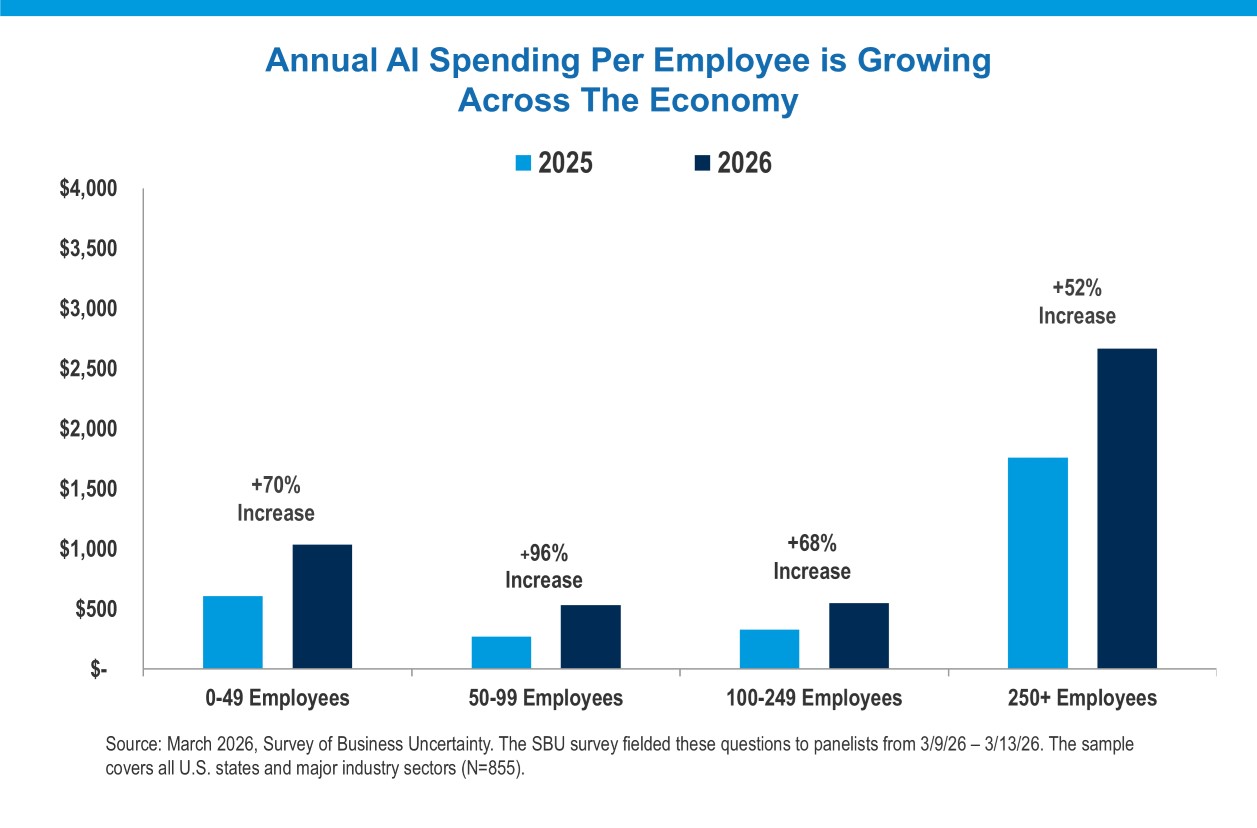
- A recent survey conducted by economists at the Federal Reserve Bank of Atlanta, in collaboration with academic researchers, revealed that spending on AI is broadening across the economy. In the survey, AI spending was defined to include “software, subscription services, hardware, worker training, and IT staff support.” While most of the investment is currently concentrated in large firms, including cloud hyperscalers, smaller firms are rapidly increasing their AI spending. As shown above, companies with fewer than 100 employees are expecting to nearly double their AI investment in 2026, growing at a significantly faster pace than those with more than 250 employees, albeit from a smaller base.
- Growth is widespread by industry. Year-over-year, construction and real estate spending on AI grew 47%, manufacturing 34%, and retail 39%. Business and professional services lead at 74%, which we attribute to its high concentration of knowledge-based tasks well-suited to AI tools.
- We believe this survey supports the view that AI investment is becoming more pervasive, with meaningful growth potential as model capabilities improve and companies integrate AI more effectively into their workflows. While larger firms still account for the bulk of AI spending, smaller firms may accelerate the overall pace of AI investment as they grow faster and narrow the gap. In our view, this bodes well for AI enablers, such as the providers of logic, memory, networking and power that form the foundation of AI services.
Visit our
Alger On the Money archive to see more charts from our weekly series.
The views expressed are the views of Fred Alger Management, LLC (“FAM”) and its affiliates as of May 2026. These views are subject to change at any time and may not represent the views of all portfolio management teams. These views should not be interpreted as a guarantee of the future performance of the markets, any security or any funds managed by FAM. These views are not meant to provide investment advice and should not be considered a recommendation to purchase or sell securities.
Risk Disclosures: Investing in the stock market involves risks, including the potential loss of principal. Growth stocks may be more volatile than other stocks as their prices tend to be higher in relation to their companies’ earnings and may be more sensitive to market, political, and economic developments. Past performance is not indicative of future performance. Investors whose reference currency differs from that in which the underlying assets are invested may be subject to exchange rate movements that alter the value of their investments. Companies involved in, or exposed to, AI-related businesses may have limited product lines, markets, financial resources or personnel as they face intense competition and potentially rapid product obsolescence, and many depend significantly on retaining and growing their consumer base. These companies may be substantially exposed to the market and business risks of other industries or sectors, and may be adversely affected by negative developments impacting those companies, industries or sectors, as well as by loss or impairment of intellectual property rights or misappropriation of their technology. Companies that utilize AI could face reputational harm, competitive harm, and legal liability, and/or an adverse effect on business operations as content, analyses, or recommendations that AI applications produce may be deficient, inaccurate, biased, misleading or incomplete, may lead to errors, and may be used in negligent or criminal ways. AI companies, especially smaller companies, tend to be more volatile than companies that do not rely heavily on technology.
Important Information for US Investors: This material must be accompanied by the most recent fund fact sheet(s) if used in connection with the sale of mutual fund and ETF shares. Fred Alger & Company, LLC serves as distributor of the Alger mutual funds and ETFs.
Important Information for UK and EU Investors: This material is directed at investment professionals and qualified investors (as defined by MiFID/FCA regulations). It is for information purposes only and has been prepared and is made available for the benefit investors. This material does not constitute an offer or solicitation to any person in any jurisdiction in which it is not authorized or permitted, or to anyone who would be an unlawful recipient, and is only intended for use by original recipients and addressees. The original recipient is solely responsible for any actions in further distributing this material and should be satisfied in doing so that there is no breach of local legislation or regulation.
Certain products may be subject to restrictions with regard to certain persons or in certain countries under national regulations applicable to such persons or countries.
Alger Management, Ltd. (company house number 8634056, domiciled at 85 Gresham Street, Suite 308, London EC2V 7NQ, UK) is authorised and regulated by the Financial Conduct Authority, for the distribution of regulated financial products and services. FAM, Weatherbie Capital, LLC, and/or Redwood Investments, LLC, U.S. registered investment advisors, serve as sub-portfolio manager to financial products distributed by Alger Management, Ltd.
Alger Group Holdings, LLC (parent company of FAM and Alger Management, Ltd.), FAM, and Fred Alger & Company, LLC are not authorized persons for the purposes of the Financial Services and Markets Act 2000 of the United Kingdom (“FSMA”) and this material has not been approved by an authorized person for the purposes of Section 21(2)(b) of the FSMA.
Important information for Investors in Israel: Fred Alger Management, LLC is neither licensed nor insured under the Israeli Regulation of Investment Advice, of Investment Marketing, and of Portfolio Management Law, 1995 (the "Investment Advice Law"). This document is for information purposes only and should not be construed as an offering of Investment Advisory, Investment Marketing or Portfolio Management services (As defined in the Investment Advice Law). Services regulated under the Investment Advice Law are only available to investors that fall within the First Schedule of Investment Advice Law ("Qualified Clients"). It is hereby noted that with respect to Qualified Clients, Fred Alger Management, LLC is not obliged to comply with the following requirements of the Investment Advice Law: (1) ensuring the compatibility of service to the needs of client; (2) engaging in a written agreement with the client, the content of which is as described in section 13 of the Investment Advice Law; (3) providing the client with appropriate disclosure regarding all matters that are material to a proposed transaction or to the advice given; (4) a prohibition on preferring certain Securities or other Financial Assets; (5) providing disclosure about "extraordinary risks" entailed in a transaction (and obtaining the client's approval of such transactions, if applicable); (6) a prohibition on making Portfolio Management fees conditional upon profits or number of transactions; (7) maintaining records of advisory/discretionary actions. This document is directed at and intended for Qualified Clients only.
Alger pays compensation to third party marketers to sell various strategies to prospective investors.