Every major technological shift creates winners and losers. The challenge for investors is that passive indexes can own both.AI Is Creating a Different Type of Investment Cycle Artificial intelligence (AI) has become one of the most important investment themes in global equity markets, but the opportunity is unlikely to be evenly distributed. As with prior technological shifts, some companies may stand to benefit from disruption while others may face pressure on their business models, competitive positioning, or pricing power.
That distinction is central to the case for active management in the AI era. Passive indexes can provide broad market exposure, but the same index that owns the companies driving disruption can also own the companies vulnerable to it. In our view, identifying the firms best positioned for this environment requires more than recognizing that AI demand is growing. It requires a deep understanding of the technology and where value might accrue, where demand is most durable, where bottlenecks are forming, and which companies can convert those forces into sustainable earnings growth.
Historical perspective helps. The market potential of an emerging technology is inherently difficult to project in its early stages, and the record shows how wide of the mark consensus can be. As Figure 1 illustrates, initial projections for wireless subscribers, personal computer users, internet users, and smartphone shipments all fell well short of actual, in some cases by orders of magnitude. Forecasters extrapolated from the constraints of the day, including expensive hardware, clunky devices, and narrow use cases, and could not foresee the innovations that would remove them.
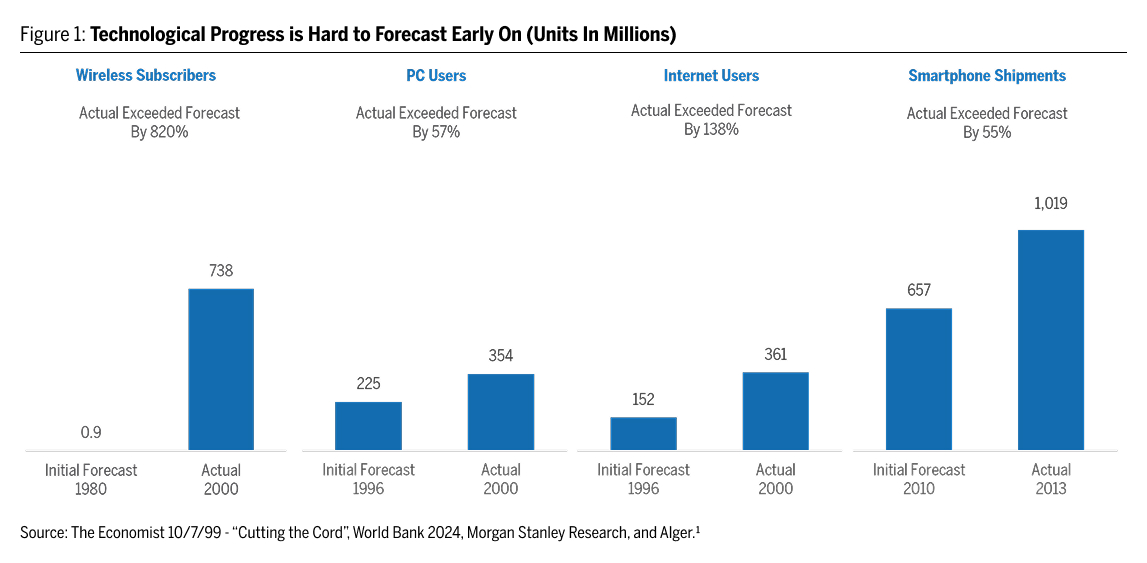
The pattern repeats because technological adoption rarely follows a straight line. Skeptics judge a new technology by its current limitations. Once costs fall and capabilities improve, network effects carry products into the mainstream faster than consensus expects. History therefore argues for keeping an open mind about the size of the AI opportunity.
AI Adoption at Warp Speed Artificial intelligence is spreading faster than any general-purpose technology before it, and as Figure 2 shows, the time from U.S. market entry to 50% penetration has compressed from several decades to just a few years. This acceleration reflects how innovations build on one another: smartphones leveraged mobile broadband and the internet; social media leveraged smartphones and app stores. Each wave of technology leaves behind infrastructure and users that the next one builds on, so every new product launches into a larger ready-made market than the last.
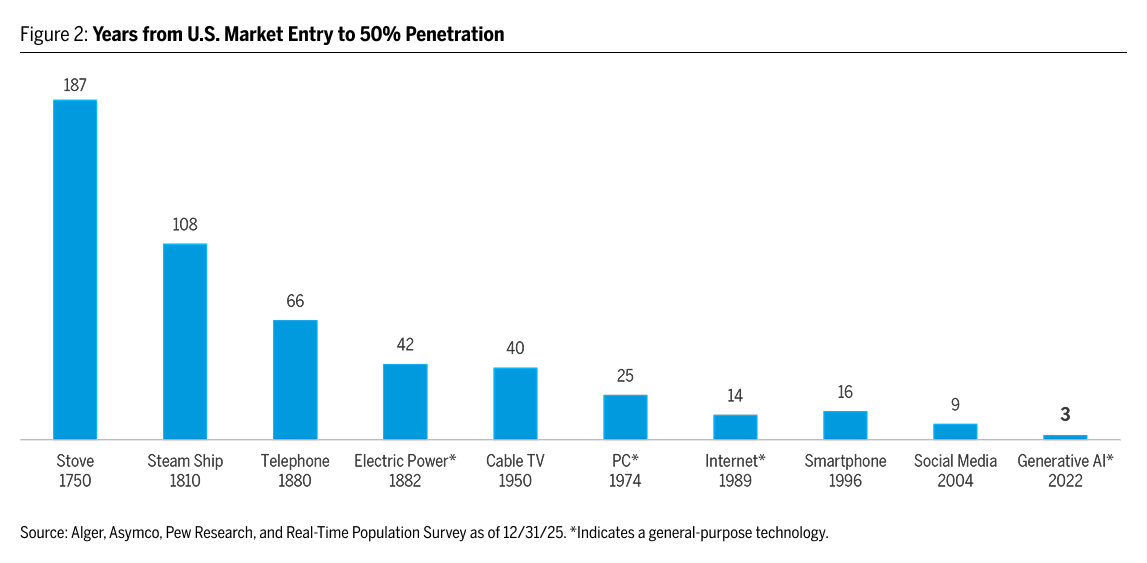
Generative AI is the fastest-growing general-purpose technology on record, largely because the ecosystem beneath it was already built. The internet needed years of infrastructure investment before it could be widely used, whereas AI arrived with cloud computing, broadband, and billions of connected devices in place. In our view, sustained adoption could support long-term demand growth for enablers such as semiconductor manufacturers, power generators, and database providers, while adopters in areas like digital advertising and genetic testing could capture meaningful productivity gains. The same forces accelerating AI adoption could also cause competitive disruption to unfold more quickly. During the internet era, changes in industry structure often played out over many years. In the AI era, companies in newly affected industries may have much less time to adapt as new capabilities are distributed through existing cloud, software, and mobile networks. Passive indexes do not make forward-looking judgments about which companies are likely to benefit from these shifts. Their holdings and weights are determined by index methodology rather than an assessment of whether AI will strengthen or weaken a company’s long-term earnings potential. Active managers, by contrast, can adjust exposure as competitive positions, valuations, and expected returns change.
Indexes Own the Disruptors and the Disrupted In periods of rapid technological change, markets often struggle to separate long-term compounders from companies that are merely attached to a powerful theme. Enthusiasm for a theme can lift valuations across the board, rewarding companies with genuine earnings power alongside those with little more than a compelling story.
Broad market exposure includes companies on both sides of disruption. During prior technological transitions, Ecommerce created powerful digital platforms and new logistics and payments ecosystems, while many traditional retailers lost market share. Social media produced new advertising and communications models while weakening the economics of some legacy media businesses.
Today as AI adoption grows, active managers can address both sides of the divide: owning the AI beneficiaries while sidestepping businesses in secular decline. In addition, active managers can uncover opportunities that are not fully reflected in index weights. Some potentially attractive companies may sit deeper in the AI supply chain, including providers of memory, power equipment, data infrastructure, and other critical technologies. These firms may represent relatively modest index positions that belie an active manager’s view on their potential importance to future AI investment and resulting earnings growth.
Following the Money Across the AI Stack Understanding where AI may create lasting shareholder value requires following the flow of investment across the entire supply chain. Hundreds of billions of dollars are being committed to processors, memory, data infrastructure, power generation, electrical equipment, and other enabling technologies. Yet spending alone does not determine investment returns. Active research is needed to assess which parts of the supply chain possess durable demand, constrained supply, pricing power, and the ability to translate AI investment into sustained earnings growth.
Compute infrastructure remains one of the largest areas of AI investment, as frontier models require increasingly powerful processing capabilities to handle intense AI workloads. However, AI is changing the type of computing infrastructure companies need. Spending is increasingly shifting from general-purpose CPU servers toward systems built around GPUs and other chips designed to perform many AI calculations in parallel. A similar shift is occurring in data management, as AI applications require platforms that can quickly organize and retrieve large amounts of complex and unstructured data. As these transitions unfold, some technology providers may gain market share while others risk losing relevance.
Memory is another area where AI may be reshaping industries. AI workloads require significantly more advanced memory capacity to keep processors fully utilized, increasing demand for high-bandwidth memory, where supply may remain constrained. Historically, memory has often behaved like a cyclical commodity business, but AI could create more durable demand for certain advanced products. Distinguishing a cyclical upturn from a structural change is what separates informed positioning from broad thematic exposure.
Power is also becoming an increasingly important part of the AI investment story. Data centers require large and reliable electricity supplies, and access to power may become a constraint on AI deployment in some regions where grid connections can take several years. That could expand the opportunity set beyond traditional technology companies to include utilities, electrical equipment providers, and infrastructure firms. But not every company will benefit equally, reinforcing the importance of selectivity and fundamental research.
AI’s Interconnected Risks and Opportunities
Each layer of the AI stack depends on the others, and as a result a bottleneck in one area can cascade through the rest. Scarce memory can reduce compute efficiency. Power supply constraints can delay data center deployment. Delayed data center construction can affect demand for chips, equipment, and services. This interdependence can create significant risks and opportunities, not all of which are reflected in passive index exposure.
AI disruption does not stop at the infrastructure layer. In enterprise software, new AI tools may allow customers to perform tasks that previously required several separate applications, potentially reducing demand for some established products. IT services firms could face pressure if AI automates coding, testing, customer support, and other work traditionally performed by large teams. Ride-hailing companies may also be disrupted if autonomous vehicles reduce the importance of driver networks and shift more of the industry’s economics toward the companies that develop or own the vehicles and technology. At the same time, incumbents with valuable data, strong customer relationships, or difficult-to-replace products may use AI to strengthen their positions.
Across these industries, AI may strengthen certain incumbents, create new leaders, and weaken businesses whose products or competitive advantages become less valuable. Passive indexes can provide exposure to all three groups. The role of active research is to determine which companies are most likely to emerge with stronger competitive positions and more durable earnings.
Identifying AI Winners Through Fundamental Research Most growth investors already own companies tied to AI in some form. The challenge is determining which holdings can continue to grow revenue, protect margins, and generate attractive returns on capital as industry dynamics shift. Answering this requires separating real demand from hype, sustainable pricing power from temporary supply-demand imbalances, and disciplined investment from spending that may never earn its cost of capital.
At Alger, our investment philosophy has long centered on positive dynamic change, which involves identifying companies benefiting from meaningful shifts before their potential is fully reflected in market expectations. AI is a powerful example. It is creating new sources of demand, new infrastructure constraints, and new avenues for productivity growth. At the same time, it may weaken established competitive advantages and pressure companies whose products, services, or business models become less valuable. In our view, evaluating both sides of that change is essential to investing in the AI era.
AI’s rapid adoption is likely to create substantial opportunities, but we believe the benefits will be unevenly distributed. Some companies may translate AI investment into durable revenue growth, stronger margins, and deeper competitive advantages. Others may benefit only temporarily, struggle to earn an adequate return on investment, or find that AI weakens the value of their existing products and services. Passive indexes can provide broad participation in this transition, but they do not distinguish among these potential outcomes. Disciplined fundamental research and active security selection may help investors identify where AI is creating lasting value while managing exposure to businesses most vulnerable to disruption.
For investors seeking actively managed exposure to companies benefiting from AI-driven change, Alger’s portfolios provide access to the firm’s bottom-up growth investing approach. Visit Alger.com for more information.