Research suggests that managers’ highest conviction holdings outperform the more diversified fund products in which they are found. So why not cut to the chase and invest solely in portfolio managers’ best ideas? We believe research supports the merits of doing exactly that with focused portfolios.
Warren Buffett sums up the most important thing to remember in investing by referencing Ted Williams’ book “The Science of Hitting” where the famed hitter and last batter to hit over .400 said his secret was to wait for the right pitch. Buffett commented “And that’s exactly the philosophy I have about investing—wait for the right pitch, and wait for the right deal. And it will come… It’s the key to investing.”
Just as hitters have different views about what is a good pitch for them to hit, portfolio managers have varying conviction levels about their holdings in diversified portfolios. Research supports the idea that managers’ highest conviction positions are most likely to outperform. As a result, focused portfolios, or those with 50 or fewer holdings, have increased potential to generate alpha. In this paper, we highlight studies that support the merits of focused portfolios and propose an alternative method of using diversification for managing risk.
The Best Ideas Often Outperform
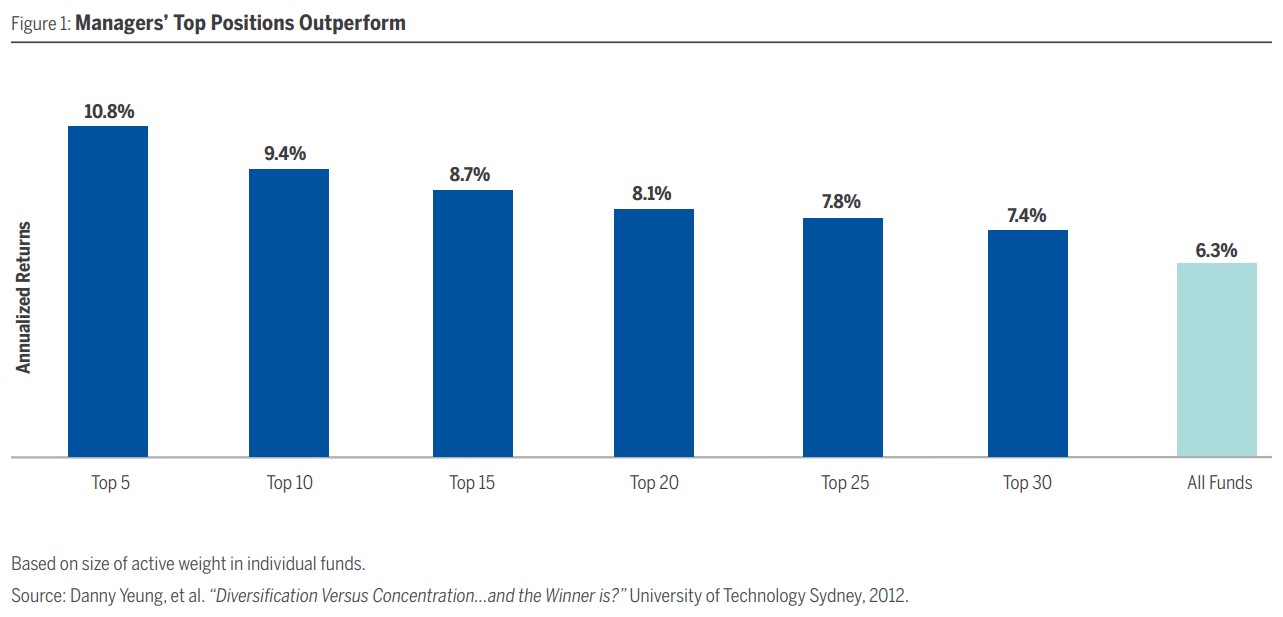
Research suggests that stock pickers’ favorite holdings, or high conviction positions, are more likely to outperform both lower conviction stocks and the broad market. In a paper entitled “Diversification versus Concentration…and the Winner is?” researchers argue that concentrated or focused portfolios outperform more diversified ones.
1 The researchers looked at more than 4,700 mutual funds over a decade and converted the funds to concentrated portfolios based on the largest active positions (i.e., the holdings where the funds’ weightings differed most from their benchmarks). The authors found that these focused portfolios significantly outperformed the diversified (actual) funds and their benchmarks (see Figure 1). The results proved compelling even when adjusted for risk.
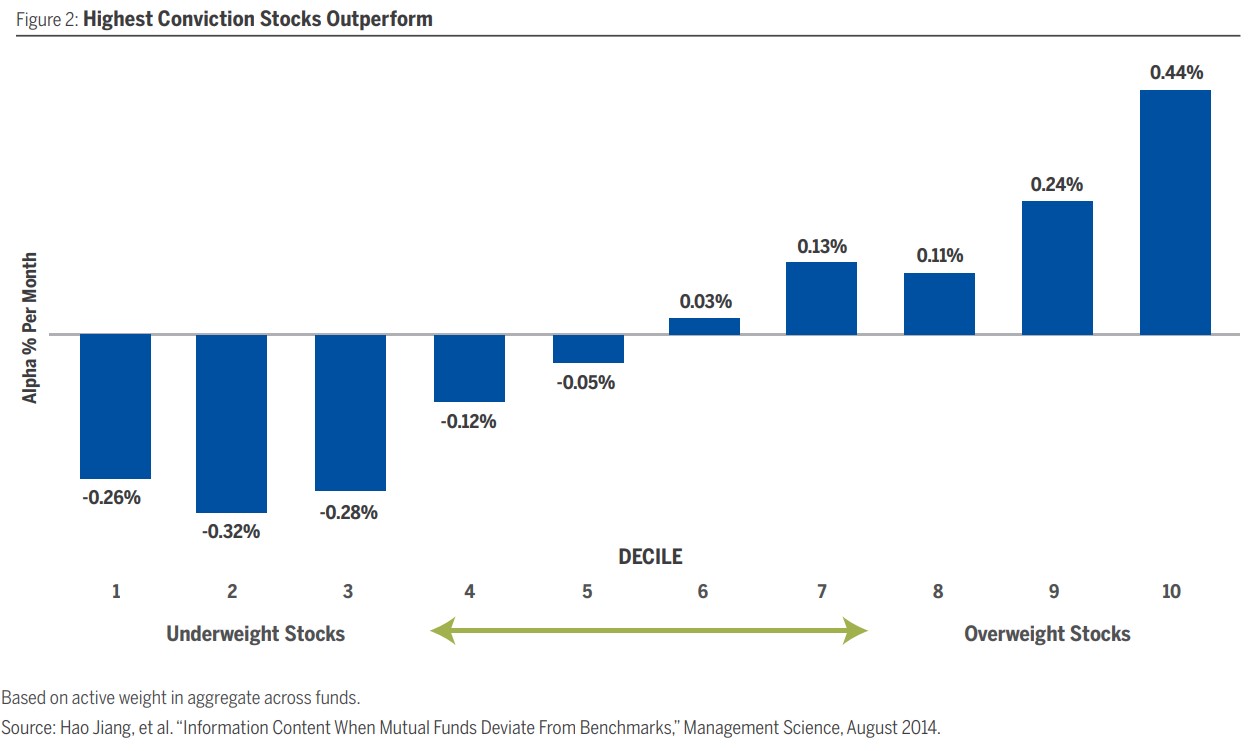
Another research paper, titled “Information Content When Mutual Funds Deviate From Benchmarks,” came to a similar conclusion.
2 In producing the paper, researchers created portfolios based on the stocks that were heavily over-weighted, in aggregate, by the managers. The analysis suggests that managers’ highest-conviction equity holdings outperform (see Figure 2).
Given that managers’ highest conviction ideas tend to outperform, it is reasonable to assume that funds that invest in relatively fewer securities would outperform as well. These strategies would benefit not only from the higher weightings of portfolio managers’ best ideas but also from the more acute attention that managers can pay to these positions. This increased attention to high conviction ideas can result from portfolio managers not being distracted by following other holdings.
A study titled “Fund Managers Who Take Big Bets: Skilled or Overconfident?” supports these ideas.
3 The study results “suggest that funds with focused managers outperform more broadly diversified funds.” The authors conclude that “mutual fund investors may enhance their overall performance by investing in portfolios of focused funds rather than highly diversified funds.”
Implications for Investors
There are two broad conclusions from research on focused portfolios. First, portfolio managers may be more skilled than their track records imply given that their largest active positions tend to outperform. Portfolio managers’ overall returns, however, are diluted by low-conviction positions that more closely track benchmarks.
Second, and more important from an investment policy standpoint, investors’ best approach may be to allocate capital to multiple focused strategies rather than trying to pursue broad diversification at the portfolio manager level.
The mutual fund industry has evolved over the years to effectively offer one-stop shopping. Investors have generally bought broadly diversified portfolios that minimize risk relative to benchmarks, or tracking error, while seeking relative outperformance. However, the increased risk mitigation by the industry may have gone too far. Trying to reduce idiosyncratic risk in individual portfolios may be antithetical to the quest for alpha. Support for this idea comes from the recent paper “Conviction in Equity Investing” in which the authors show that strategies that take higher levels of active risk (i.e. tracking error) generate stronger alpha.
4 Risk management may be better handled by using a combination of focused portfolios to implement asset allocation targets rather than having individual managers invest in a large number of holdings. Indeed, one of the major implications from the first research paper cited was that “there may be better ways for investors to achieve diversification rather than requiring it to be done for them by their fund managers.” In our view, if investors want more alpha, they should accept more volatility or tracking error in individual strategies. Putting multiple focused funds together in a thoughtful asset allocation approach may preserve the benefits of managers’ skills while providing the desired diversification.
5 In aggregate, the research cited in this paper suggests that diversification is diluting what would otherwise be stronger returns. That data supports the idea that focused strategies may be able to remedy challenges associated with excessive diversification at the individual fund level and therefore produce better results. Investors who allow fund managers to swing only at the best pitches should stand a better chance of winning.
THE SEARCH SHIFTS
Institutional investors are highly regarded for their disciplined and research-driven approach to selecting asset managers. With that in mind, we think valuable insight can be gained by assessing the characteristics that institutional investors scrutinize when conducting manager searches. In conducting screens, the “number of holdings” characteristic is now among the most popular criteria that institutional investors currently evaluate, according to eVestment, which provides a database of institutional portfolio managers and other analytical products. The number of holdings characteristic is used more often than such popular metrics as annualized alpha, portfolio manager experience, active share, and fees. Most importantly, more than threequarters of the screens utilizing number of holdings sought portfolios with fewer than 50 positions.6
View the PDF