Log In
Alger
  • About Alger
    • Our History
      Our Investment Approach
      Investment Team
      Careers
      Commitment to Sustainability
      Commitment to Culture & Employees
      Charitable Giving
      We Remember
  • Strategies
    • Strategies Overview
      Asset Classes
      Vehicles
      Strategy Finder
      Large Cap
      Mid Cap
      Small/SMid Cap
      International
      Alternatives
      Specialty
      Focus
      Mutual Funds
      ETFs
      Interval Funds
      SMAs
      Institutional Separate Accounts
      UCITS
      Collective Investment Trusts
  • Insights
    • Insights
      Blogs
      Alger On the Money
      Alger On the Record
      Manager Commentary
      Capital Markets Outlook
      Retirement Solutions
      Viewpoints
      The Power of Focus
  • Newsroom
    Press ReleasesIn the News
  • Contact Us
PART ONE IN THE BEHAVIORAL FINANCE SERIES
.st0 { fill: #999999; } Explore Insights .st0 { fill: #999999; } Subscribe to Emails .st0 { fill: #999999; } .st0 { fill: #999999; } Download PDF

Solomon's Paradox

Brad Neuman's Photo

Brad Neuman, CFA;

Senior Vice President
Director of Market Strategy

Whose advice should you trust? The advice you give yourself may be sound as long as you can distance yourself from your situation. This so-called self-distancing can enable you to make wiser decisions in both investing and life in general.

​

Whose advice should you trust? It sounds like a daunting question but research suggests that the answer is closer at hand than you might think. The advice you give yourself may be very sound as long as you can distance yourself from your situation. This so-called self-distancing can enable you to make much wiser decisions in both investing and life in general.


A Wise King but a Not-So-Wise Man

King Solomon, who ruled from about 970 BC to 931 BC, was said to be one of the wisest monarchs of ancient times. People reportedly traveled great distances to seek his counsel. One famous story recounts an argument between two women who both claimed to be the same boy’s mother. King Solomon’s solution was to call for a sword and split the baby into two. Upon hearing this, one woman said, “It shall be neither mine nor yours—divide it!” while the other cried out, “Give the baby to her! Just don’t kill him!” The king declared the second woman to be the true mother.

However, the king was much less wise in dealing with his own affairs. He did several imprudent things, including taking hundreds of wives and amassing more wealth than ever needed. In addition, he failed at raising his son to become a just and fair ruler, which ultimately led to his people rebelling and the kingdom fracturing.

One’s ability to reason more sensibly about someone else’s problems than one’s own is known in psychology as Solomon’s Paradox.

Self-Distancing

There may be a solution for Solomon’s Paradox that can turn flawed thinking into astute counsel. Research shows that self-distancing or the act of removing one’s own ego or circumstances from a situation may lead to better decision-making.

Dr. Igor Grossmann and Dr. Ethan Kross designed a reasoning experiment in which people were divided into two groups: the self and other groups. The self-group’s reasoning skills were assessed in response to hypothetically discovering their significant others were unfaithful while the other-group’s reasoning skills were assessed after a friend hypothetically discovered that a significant other had been unfaithful. The self-group scored much lower on the reasoning test than the other-group. Basically, “people are wiser when reasoning about others’ problems than reasoning about their own problems.”

Then the researchers further divided the subjects. They were instructed to think about the situation from two perspectives (Figure 1):

  1. Self-immersed: first person reasoning such as why am I feeling this way or
  2. Self-distanced: third person reasoning such as why is he/she feeling this way.
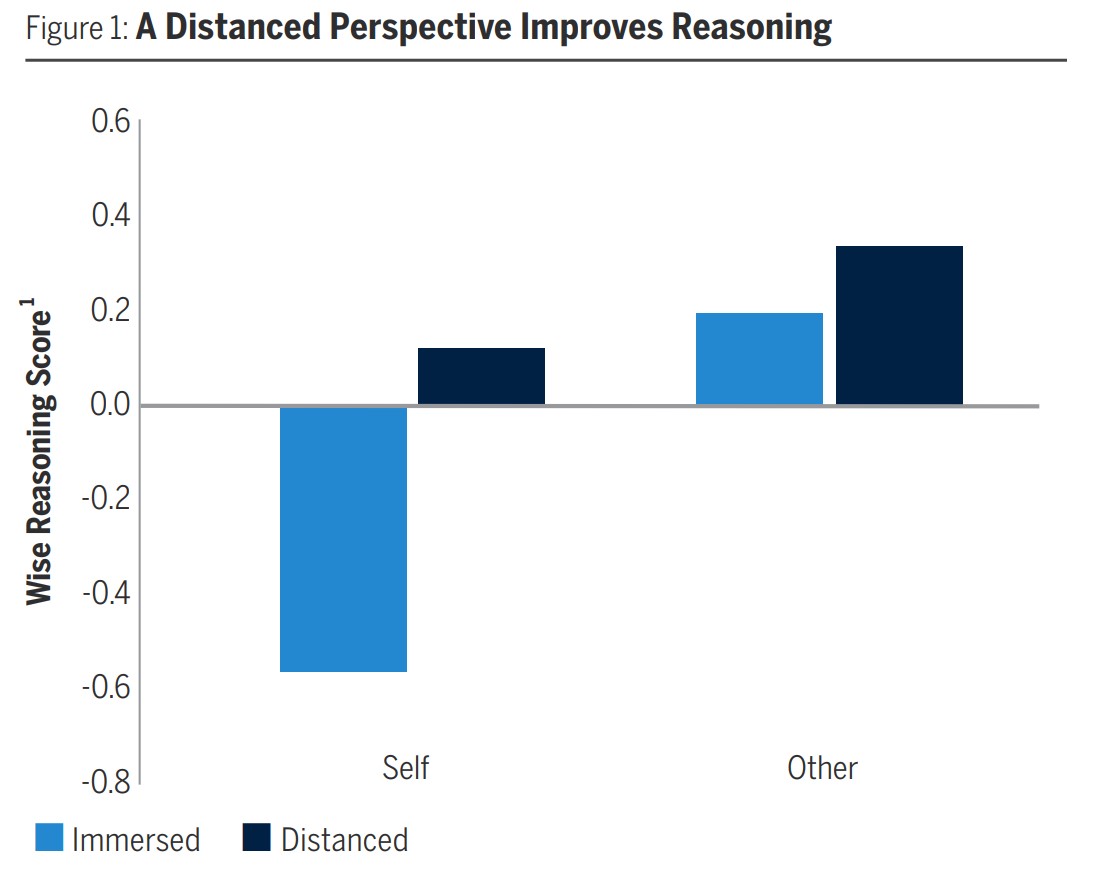
Figure 1 Bar Chart showing a distanced perspective improves reasoning on the Wise Reasoning Score​

Source: Grossmann and Kross.


​

People who reasoned from a self-distanced perspective showed higher wisdom scores, regardless of whether the situation involved themselves or their friend. The conclusion is that simply distancing yourself from your own situation can help improve your reasoning ability.

Application to Investing

We believe the self-distancing principle applies to investing as well. Investors certainly have many biases that get in the way of making rational decisions. For example, when people consider buying or selling a stock, they may be influenced by a range of issues specific to their own experience, such as whether they have embedded gains or losses. This should not have any impact on a rational decision in a non-taxable account, yet time and again it comes into play.

Some investors who incorporate extraneous information into their decision-making process suffer from loss aversion, where it is harder to realize a loss than a gain, even when the prospective future returns remain the same. Others may be so caught up in a rising stock price that they fall victim to confirmation bias and ignore important fundamental developments or stop doing research altogether. Finally, some investors may even be biased by not having any exposure at all and join the investing herd at an inopportune time, driven by regret aversion, commonly referred to as fear of missing out. These biases are reasons individual investors often underperform the underlying asset classes in which they invest. For example, Morningstar estimates that the average investor in diversified U.S. mutual funds & ETFs under-performed the actual returns of those funds by approximately 120bps annually in the 10 years ending 2024.2

A distanced perspective may be a good way to combat investor biases that lead to underperformance. An outsider would likely be less affected by an investor’s personal situation. Therefore, similar to the experiment in which utilizing third person reasoning delivered a wiser decision, self-distancing should be an effective tool to mitigate investment biases, refocus on objective facts, and create better performance results.

​

Recommended Insights for You:

1 Grossmann and Kross, “Exploring Solomon’s Paradox: Self-Distancing Eliminates the Self-Other Asymmetry in Wise Reasoning about Close Relationships in Young and Older Adults,” May 19, 2014.

2 Morningstar Mind The Gap 2025. The calculation compares aggregate dollar-weighted (IRR) returns based on fund cash flows with time-weighted (buy-and-hold) returns. The performance data quoted represents past performance, which is not an indication or a guarantee of future results.

​
The views expressed are the views of Fred Alger Management, LLC (“FAM”) and its affiliates as of June 2026. These views are subject to change at any time and may not represent the views of all portfolio management teams. These views should not be interpreted as a guarantee of the future performance of the markets, any security or any funds managed by FAM. These views are not meant to provide investment advice and should not be considered a recommendation to purchase or sell securities.

Risk Disclosures: Investing in the stock market involves risks, including the potential loss of principal. Growth stocks may be more volatile than other stocks as their prices tend to be higher in relation to their companies’ earnings and may be more sensitive to market, political, and economic developments.

This material must be accompanied by the most recent fund fact sheet(s) if used in connection with the sale of mutual fund and ETF shares. Fred Alger & Company, LLC serves as distributor of the Alger mutual funds and ETFs.

Alger pays compensation to third party marketers to sell various strategies to prospective investors.

A subscription fee is paid to Morningstar to access research, ratings, rankings and other investment tools.

Fred Alger Management, LLC 100 Pearl Street, New York, NY 10004 / www.alger.com

SPWP0626
​

RecommendedContent Title

ETF Investors

This ETF is different from traditional ETFs.

Traditional ETFs tell the public what assets they hold each day. This ETF will not. This may create additional risks for your investment. Specifically:

You may have to pay more money to trade the ETF’s shares. This ETF will provide less information to traders, who tend to charge more for trades when they have less information.

The price you pay to buy ETF shares on an exchange may not match the value of the ETF’s portfolio. The same is true when you sell shares. These price differences may be greater for this ETF compared to other ETFs because it provides less information to traders.

These additional risks may be even greater in bad or uncertain market conditions.

The differences between this ETF and other ETFs may also have advantages. By keeping certain information about the ETF confidential, this ETF may face less risk that other traders can predict or copy its investment strategy. This may improve the ETF’s performance. If other traders are able to copy or predict the ETF’s investment strategy, however, this may hurt the ETF’s performance. For additional information regarding the unique attributes and risks of this ETF, please refer to the prospectus.

ABOUT ALGER

  • Our History
  • Our Investment Approach
  • Investment Team
  • Careers
  • Charitable Giving
  • We Remember
  • Documents & Forms
  • Fund Literature
  • FAQs

ESG

  • Commitment to Sustainability
  • Alger's Approach to ESG Investing and Oversight
  • Weatherbie’s Approach to ESG Investing and Oversight
  • Redwood's Approach to Responsible Investing
  • Commitment to Culture & Employees

ASSET CLASSES

  • Large Cap
  • Mid Cap
  • Small/SMid Cap
  • International
  • Alternatives
  • Specialty
  • Focus

VEHICLES

  • Mutual Funds
  • ETFs
  • Interval Funds
  • SMAs
  • Institutional Separate Accounts
  • UCITS
  • Collective Investment Trusts

TOOLS

  • Strategy Finder
  • 10 Year Estimator
  • Quarterly Expense Estimator

INSIGHTS

  • Featured Insights
  • Capital Markets Outlook
  • Alger On the Money
  • Alger On the Record
  • The Alger Podcast
  • Search All Insights

NEWSROOM

  • Press Releases
  • In the News

LITERATURE

  • Mutual Funds
  • SMAs
  • Institutional Separate Accounts
  • UCITS

CONTACT US

  • All Inquiries

LEGAL NOTICES

  • Proxy Information
  • 2026 Estimated Dividends & Distribution Information
  • Sales Charges
  • Customer Relationship Summaries
  • UK Investor Report
  • Form ADVs
  • Interval Fund Repurchasing Schedule
View Mobile Site

Copyright Alger All Rights Reserved Privacy Policy Business Continuity Terms and Conditions
youtube channel LinkedIn Instagram