Log In
Alger
  • About Alger
    • Our History
      Our Investment Approach
      Investment Team
      Careers
      Commitment to Sustainability
      Commitment to Culture & Employees
      Charitable Giving
      We Remember
  • Strategies
    • Strategies Overview
      Asset Classes
      Vehicles
      Strategy Finder
      Think Further For Retirement
      Large Cap
      Mid Cap
      Small/SMid Cap
      International
      Alternatives
      Specialty
      Focus
      Mutual Funds
      ETFs
      SMAs
      Institutional Separate Accounts
      UCITS
      Collective Investment Trusts
  • Insights
    • Insights
      Blogs
      Alger On the Money
      Alger On the Record
      Manager Commentary
      Capital Markets Outlook
      Retirement Solutions
      Viewpoints
      The Power of Focus
  • Newsroom
    Press ReleasesIn the News
  • Contact Us
CommentaryMarket Insight
.st0 { fill: #999999; } Explore Insights .st0 { fill: #999999; } Subscribe to Emails .st0 { fill: #999999; } .st0 { fill: #999999; } Download PDF

Loss Illusion: Rethinking Small Cap Quality In The Intangible Era

Brad Neuman's Photo

Brad Neuman, CFA;

Senior Vice President
Director of Market Strategy

Small cap stocks are often viewed as lower-quality investments, as investors point to GAAP losses, inconsistent profitability, and weak returns as evidence of deteriorating fundamentals. But what if these signals are misleading?

I. Introduction: The Perception Problem​​

Small cap stocks are often viewed as lower-quality investments, particularly when evaluated using traditional accounting metrics. Investors cite sustained Generally Accept​​ed Accounting Principles (GAAP) losses, inconsistent profitability, and weak return profiles as evidence of deteriorating fundamentals. But what if these signals are misleading? Beneath the surface, many small cap firms are investing heavily in innovation and building competitive advantages through research and development (R&D), branding, and human capital. The real issue may not be the firms themselves, but the accounting framework used to evaluate them. Traditional financial statements could fail to reflect the economic value of intangible assets. As a result, investors may be systematically underestimating the quality and future potential of small cap companies.​​​

II. The Appearance of ​Weak Profitability​

Small cap companies are perceived to be significantly less profitable than the​ir large cap peers. Many large cap indices today contain a majority of consistently profitable companies, while small cap benchmarks lag. Our data suggests that approximately 40% of co​mpanies inclu​ded in the Russell 2000 index are unprofitable on an earnings basis as compared to only 6% of the large cap Russell 1000.i​ ​According to a recent paper entitled Reassessed Earnings with Capitalized Intangibles​, the two sm​​al​lest quartiles by market capitalization had negative earnings margins while the larger two quartiles were positive. Negative margins indicate these companies spend more to operate than they currently earn in gross profit from​ sales, at least according to traditional accounting metrics. This apparent fundamental deficiency has led investors to question the competitiveness of small cap businesses.ii

​​​Profitability in the small cap universe also ap​pears to have declined over time. As shown in Figure 1, the proportion of companies with negative earnings has approximately doubled over the past two decades. While this is directionally consistent with the trend in large cap companies as well, the trend in small cap is more profound. This long-term shift has ​contributed to the perception that small caps are structurally weaker than they once were, both in absolute terms and relative to their large cap peers. ​
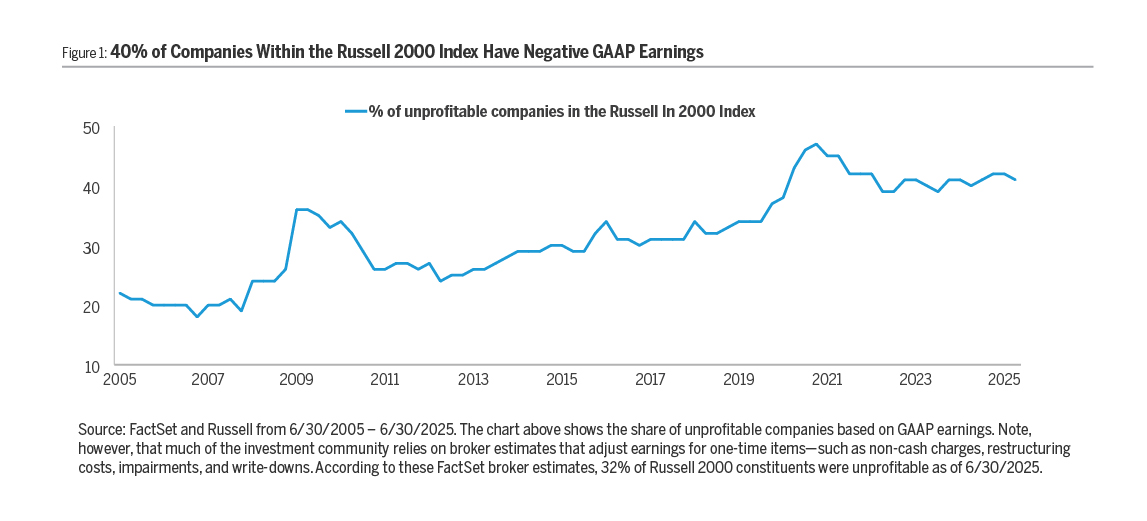
40% of Companies Within the Russell 2000 Index Have Negative GAAP Earnings

III. The Shift to Intangible Investment​

However, the data may not reflect true economic performance. Traditional accounting rules, and particularly GAAP-based earnings, might fail to account for how companiesare increasingly building value through intangible assets—such as R&D, employee training, and brand development. Over the past several decades, the nature of corporate investment has changed dramatically. According to national accounts data, the share of GDP devoted to intangible investment has nearly tripled since 1980, while tangible investment has steadily declined.iii
​
Despite their rising importance, accounting rules treat intangible investments very differently from tangible investments. Physical assets like factories or equipment are capitalized and depreciated over time, allowing their cost to be spread across the years in which they contribute value. Intangible investments, by contrast, are typically expensed immediately under GAAP. This means they more significantly reduce current earnings—even when they are long-term investments that build enduring competitive advantage. As intangible intensity rises, this accounting treatment increasingly distorts financial statement metrics, punishing the profitability of firms that invest substantially in intangible assets and creating a misleading picture of firm economics.
​
For instance, consider NVIDIA which designs semiconductor chips for AI computing. Since its founding in 1993, the company has invested over $60 billion in R&D, and last fiscal year spent more than four times on R&D what it spent on property, plant and equipment (PP&E). Its business is clearly driven by intangible, as opposed to tangible, assets. Yet on its balance sheet, NVIDIA records a larger asset for PP&E than intangible assets; this is not reflective of the economic reality that th​e company’s hardware designs and software programming model are worth many multiples of its tangible assets. To substantiate this, consider the several trillion dollars of market capitalization that the company commands in the stock market as compared to the more modest net asset value on its balance sheet of only approximately $80 billion—clearly much of its asset value is ​not being captured by its financial statements.
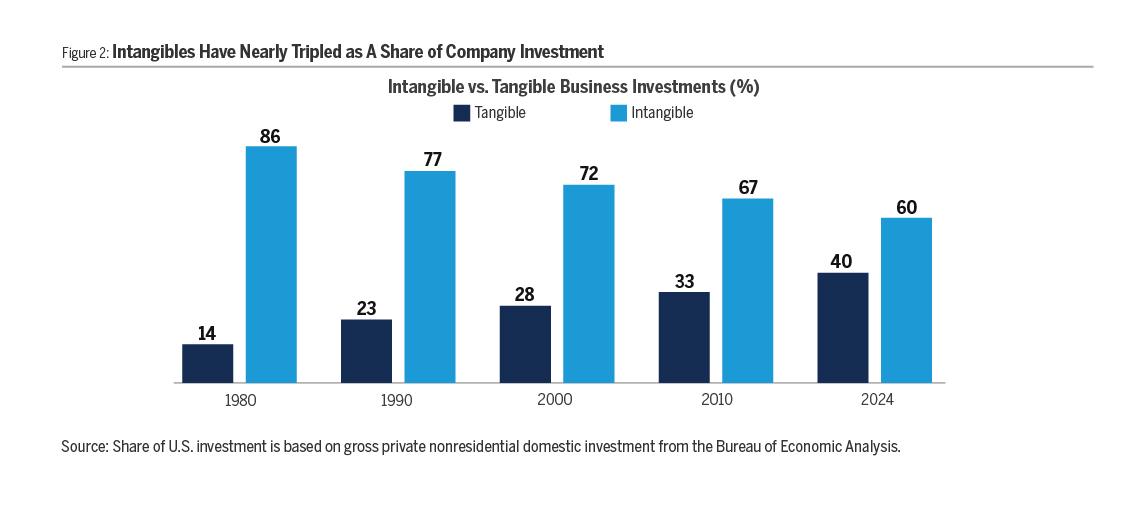
​Intangibles Have Nearly Tripled as A Share of Company Investment​

IV. Intangible Adjustments Yield More Profits​

The accounting treatment of intangible investments systematically understates earnings to such an extent that many companies appear unprofitable when they are not—once adjustments are made to treat intangible and tangible assets equivalently. Stated differently, adjusting accounting practices to treat intangible investments similarly to physical assets significantly improves perceived profitability, particularly in small cap companies, given their greater levels of investment relative to their revenue.

For example, Figure 3 illustrates a fictitious steady-state company growing revenue at 15% annually, with clearly defined costs: non-investment expenses at 60% of sales, and intangible investments (like R&D or branding) at 20% of sales, each asset having a five-year useful life. If these intangible investments are immediately expensed, operating profits appear artificially low due to the immediate hit to earnings. However, by capitalizing these investments— spreading their costs evenly over five years—the upfront expenses decrease, resulting in higher operating profits. The resulting 460 basis point improvement in operating profits underscores how traditional accounting can understate the true profitability of companies heavily investing in intangible assets. ​
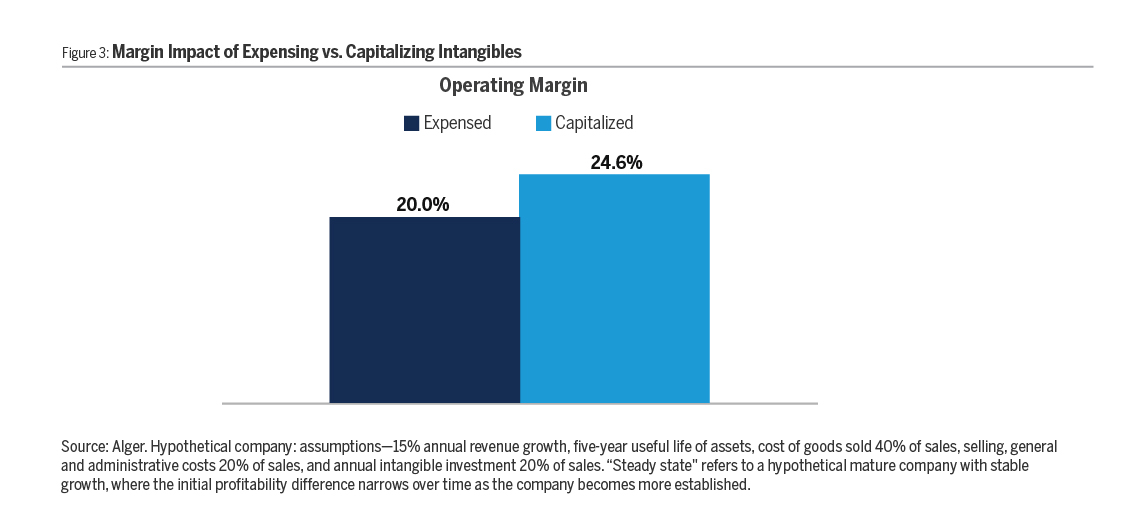
​​Margin Impact of Expensing vs. Capitalizing Intangibles ​ ​
​ In the study ​ Reassessed Earnings with Capitalized Intangibles, researchers found that modifying the accounting by capitalizing intangible investment spending partially offset by the amortization of past intangible spending would improve earnings relative to revenue for the universe of companies by nearly 900 basis points (bps). Cash flow from operations relative to revenue would be improved even more—by over 2,400 bps. Here the adjustment is to add back intangible spending (because it is reclassified as cash flow f​rom investing rather than cash flow from operations) with no corresponding amortization expense (because it is non-cash). Interestingly, adjusted earnings relative to revenue appears to have degraded less since the 1990s than reported accounting suggests, while cash flow from operations relative to revenue has actually improved over the past few decades.iv

These effects are particularly pronounced in smaller companies. The smallest quartile of companies by market capitalization would see their earnings relative to revenue improve by over 2,200 bps with this adjustment, more than twice as much as the overall universe of stocks! In fact, 15.8% of the smallest quartile of companies would be reclassified from loss making to profitable as compared to only 4.0% of the largest quartile. ​

In other words, small caps are not nearly as unprofitable as they are widely believed to be. ​

V. Reframing Quality: The Impact of Accounting Adjustments

​ ​​​Capitalizing intangible investments doesn’t just improve current profitability metrics—it enhances the overall quality of earnings. Research finds that capitalizing intangible investments better matches expenses with the revenues a company generates, giving investors a clearer view of profitability trends and reinforcing the matching principle in accrual accounting. Specifically, the correlation between contemporaneous expenses and revenues rises after intangible adjustments. The correlation improves the most for the smallest quartile of firms​, implying that the misclassification of investmentis greatest in that group of companies, likely because of their less mature cost structure.v

Earnings also become more persistent—a key indicator of earnings quality defined as the degree to which current earnings predict future earnings. This is reflected in the rise of the coefficient on lagged earnings per share (EPS) under the adjusted framework.vi In other words, the coefficient on lagged EPS tells us how much of last year’s earnings typically carries over into this year—a higher value means profits are more persistent, signaling higher quality earnings.

Finally, adjusted earnings measures better align with stock market outcomes. Firms that have reported losses but are reclassified as profitable under the adjusted approach have historically outperformed those who would continue to report losses after the effect of capitalization by over 1,600 bps on average, according to Reassessed Earnings with Capitalized Intangibles​​. These results reinforce the view that GAAP-based profitability metrics can obscure the true economic condition of innovation-oriented firms.vii​ Better alignment between expenses and revenues helps investors understand how effectively management is utilizing resources to generate sales and profit growth.

VI. ​Conclusion: Time to Rethink Small Cap Quality​

Traditional accounting significantly understates the quality of small cap companies, in our view. By expensing intangible investments rather than capitalizing them, GAAP metrics systematically reduce reported profitability, weaken measured earnings persistence, and degrade the alignment between expenses and revenues. These distortions not only misrepresent business fundamentals, but also lead to lower stock returns for firms that are in fact investing for long-term growth. While this issue impacts many public companies, small cap firms—which typically invest more heavily in R&D and other intangibles—bear the brunt of this misrepresentation, leading to misleading assessments under current frameworks.

As the economy increasingly relies on innovation and intangible assets, investors who neglect to adjust for these factors may risk overlooking tomorrow’s potential market leaders, particularly in the small cap universe. By capitalizing intangibles and aligning financial analysis with economic reality, we can reveal a clearer picture of where growth, value, ​and durability truly reside.​


​

Recommended Insights for You:

​​
iAlger calculation as of May 2025, using FactSet last 12-month data.
iiRajgopal, S., Basirianmahabadi, E., Iqbal, A., & Srivastava, A. (2024). Reassessed Earnings with Capitalized Intangibles. Columbia Business School, University of Calgary, Arizona State
iiiU.S. Bureau of Economic Analysis, National Income and Product Accounts
ivRajgopal, S., Basirianmahabadi, E., Iqbal, A., & Srivastava, A. (2024). Reassessed Earnings with Capitalized Intangibles. Columbia Business School, University of Calgary, Arizona State.
vIbid.
viIbid.​​
viiIbid.

​ ​The views expressed are the views of Fred Alger Management, LLC (FAM) and its affiliates as of July 2025. These views are subject to change at any time and may not represent the views of all portfolio management teams. These views should not be interpreted as a guarantee of the future performance of the markets, any security or any funds managed by FAM. These views are not meant to provide investment advice and should not be considered a recommendation to purchase or sell securities. Holdings and sector allocations are subject to change.

Risk Disclosures: ​Investing in the stock market involves risks, including the potential loss of principal. Growth stocks may be more volatile than other stocks as their prices tend to be higher in relation to their companies’ earnings and may be more sensitive to market, political, and economic developments. Investing in companies of small capitalizations involves the risk that such issuers may have limited product lines or financial resources, lack management depth, or have limited liquidity. Past performance is not indicative of future performance. ​Investors whose reference currency differs from that in which the underlying assets are invested may be subject to exchange rate movements that alter the value of their investments. ​Investing in innovation is not without risk and there is no guarantee that investments in research and development will result in a company gaining market share or achieving enhanced revenue. Companies exploring new technologies may face regulatory, political or legal challenges that may adversely impact their competitive positioning and financial prospects. Developing technologies to displace older technologies or create new markets may not in fact do so, and there may be sector-specific risks. There will be winners and losers that emerge, and investors need to conduct a significant amount of due diligence on individual companies to assess these risks and opportunities.

Important Information for US Investors: This material must be accompanied by the most recent fund fact sheet(s) if used in connection with the sale of mutual fund and ETF shares. Fred Alger & Company, LLC serves as distributor of the Alger mutual funds.

Important Information for UK and EU Investors: This material is directed at investment professionals and qualified investors (as defined by MiFID/FCA regulations). It is for information purposes only and has been prepared and is made available for the benefit investors. This material does not constitute an offer or solicitation to any person in any jurisdiction in which it is not authorized or permitted, or to anyone who would be an unlawful recipient, and is only intended for use by original recipients and addressees. The original recipient is solely responsible for any actions in further distributing this material and should be satisfied in doing so that there is no breach of local legislation or regulation. Certain products may be subject to restrictions with regard to certain persons or in certain countries under national regulations applicable to such persons or countries. Alger Management, Ltd. (company house number 8634056, domiciled at 85 Gresham Street, Suite 308, London EC2V 7NQ, UK) is authorised and regulated by the Financial Conduct Authority, for the distribution of regulated financial products and services. FAM, Weatherbie Capital, LLC, and/or Redwood Investments, LLC, U.S. registered investment advisors, serve as sub-portfolio manager to financial products distributed by Alger Management, Ltd. Alger Group Holdings, LLC (parent company of FAM and Alger Management, Ltd.), FAM, and Fred Alger & Company, LLC are not authorized persons for the purposes of the Financial Services and Markets Act 2000 of the United Kingdom (“FSMA”) and this material has not been approved by an authorized person for the purposes of Section 21(2)(b) of the FSMA.

Important information for Investors in Israel: Fred Alger Management, LLC is neither licensed nor insured under the Israeli Regulation of Investment Advice, of Investment Marketing, and of Portfolio Management Law, 1995 (the "Investment Advice Law"). This document is for information purposes only and should not be construed as an offering of Investment Advisory, Investment Marketing or Portfolio Management services (As defined in the Investment Advice Law). Services regulated under the Investment Advice Law are only available to investors that fall within the First Schedule of Investment Advice Law ("Qualified Clients"). It is hereby noted that with respect to Qualified Clients, Fred Alger Management, LLC is not obliged to comply with the following requirements of the Investment Advice Law: (1) ensuring the compatibility of service to the needs of client; (2) engaging in a written agreement with the client, the content of which is as described in section 13 of the Investment Advice Law; (3) providing the client with appropriate disclosure regarding all matters that are material to a proposed transaction or to the advice given; (4) a prohibition on preferring certain Securities or other Financial Assets; (5) providing disclosure about "extraordinary risks" entailed in a transaction (and obtaining the client's approval of such transactions, if applicable); (6) a prohibition on making Portfolio Management fees conditional upon profits or number of transactions; (7) maintaining records of advisory/discretionary actions. This document is directed at and intended for Qualified Clients only. Correlation is a statistical measure that shows how two variables are related to each other. If two variables are correlated, it means that they tend to move together in some way. The strength of the correlation is measured by a number called the correlation coefficient, which ranges from -1 to 1. A value of 0 indicates no correlation, a value of 1 indicates a perfect positive correlation (i.e., as one variable increases, the other increases as well), and a value of -1 indicates a perfect negative correlation (i.e., as one variable increases, the other decreases). Operating margin is a profitability ratio that measures the percentage of revenue a company retains after covering its operating expenses, excluding taxes and interest. Russell 1000® Index: Measures the performance of the large-cap segment of the US equity universe. The Russell 1000 Index is a subset of the Russell 3000® Index which is designed to represent approximately 98% of the investable US equity market. It includes approximately 1,000 of the largest securities based on a combination of their market cap and current index membership. The Russell 1000 is constructed to provide a comprehensive and unbiased barometer for the large-cap segment and is completely reconstituted annually to ensure new and growing equities are included. After March 24, 2025, FTSE Russell implemented a new methodology capping individual companies at no more than 22.5% of the index and capping companies that have a weight greater than 4.5% in aggregate at no more than 45% of the index. Russell 2000® Index: Measures the performance of the small-cap segment of the U.S. equity universe. The Russell 2000 Index is constructed to provide a comprehensive and unbiased barometer for the small-cap segment. Investors cannot invest directly in any index. Index performance does not reflect deductions for taxes. ​The performance data quoted represents past performance, which is not an indication or a guarantee of future results.

Source: London Stock Exchange Group plc and its group undertakings (collectively, the “LSE Group”). © LSE Group 2025. FTSE Russell is a trading name of certain of the LSE Group companies. “FTSE®” “Russell®”, “FTSE Russell®”, “FTSE4Good®”, “ICB®”, “Mergent®, The Yield Book®,” are trade marks of the relevant LSE Group companies and are used by any other LSE Group company under license. All rights in the FTSE Russell indexes or data vest in the relevant LSE Group company which owns the index or the data. Neither LSE Group nor its licensors accept any liability for any errors or omissions in the indexes or data and no party may rely on any indexes or data contained in this communication. No further distribution of data from the LSE Group is permitted without the relevant LSE Group company’s express written consent. The LSE Group does not promote, sponsor or endorse the content of this communication.

FactSet is an independent source, which Alger believes to be a reliable source. FAM, however, makes no representation that it is complete or accurate.

The following positions represent firm wide assets under management as of April 30, 2025: Nvidia Corporation, 11.0%. Alger pays compensation to third party marketers to sell various strategies to prospective investors.
​​

RecommendedContent Title

ETF Investors

This ETF is different from traditional ETFs.

Traditional ETFs tell the public what assets they hold each day. This ETF will not. This may create additional risks for your investment. Specifically:

You may have to pay more money to trade the ETF’s shares. This ETF will provide less information to traders, who tend to charge more for trades when they have less information.

The price you pay to buy ETF shares on an exchange may not match the value of the ETF’s portfolio. The same is true when you sell shares. These price differences may be greater for this ETF compared to other ETFs because it provides less information to traders.

These additional risks may be even greater in bad or uncertain market conditions.

The differences between this ETF and other ETFs may also have advantages. By keeping certain information about the ETF confidential, this ETF may face less risk that other traders can predict or copy its investment strategy. This may improve the ETF’s performance. If other traders are able to copy or predict the ETF’s investment strategy, however, this may hurt the ETF’s performance. For additional information regarding the unique attributes and risks of this ETF, please refer to the prospectus.

ABOUT ALGER

  • Our History
  • Our Investment Approach
  • Investment Team
  • Careers
  • Charitable Giving
  • We Remember
  • Think Further
  • Documents & Forms
  • Fund Literature
  • FAQs

ESG

  • Commitment to Sustainability
  • Alger's Approach to ESG Investing and Oversight
  • Weatherbie’s Approach to ESG Investing and Oversight
  • Redwood's Approach to Responsible Investing
  • Commitment to Culture & Employees

ASSET CLASSES

  • Large Cap
  • Mid Cap
  • Small/SMid Cap
  • International
  • Alternatives
  • Specialty
  • Focus

VEHICLES

  • Mutual Funds
  • ETFs
  • SMAs
  • Institutional Separate Accounts
  • UCITS
  • Collective Investment Trusts

TOOLS

  • Strategy Finder
  • 10 Year Estimator
  • Quarterly Expense Estimator

INSIGHTS

  • Featured Insights
  • Capital Markets Outlook
  • Alger On the Money
  • Alger On the Record
  • The Alger Podcast
  • Think Further for Retirement
  • Search All Insights

NEWSROOM

  • Press Releases
  • In the News

LITERATURE

  • Mutual Funds
  • SMAs
  • Institutional Separate Accounts
  • UCITS

CONTACT US

  • All Inquiries

LEGAL NOTICES

  • Proxy Information
  • 2025 Dividends & Distribution Information
  • Sales Charges
  • Customer Relationship Summaries
  • UK Investor Report
  • Form ADVs
View Mobile Site

Copyright Alger All Rights Reserved Privacy Policy Business Continuity Terms and Conditions
youtube channel LinkedIn Instagram