Executive Summary
A U.S. factory worker works approximately 1,700 hours a year after accounting for holidays, vacation, and sick time. A humanoid robot can operate around the clock. Even at today’s early utilization rates, it can deliver roughly 3,500 hours a year, about twice as many as a human worker, at a similar hourly cost. As utilization improves and costs decline, we estimate that its cost advantage could widen to approximately 8 to 15 times by 2031, depending on the role’s level of specialization.
For decades, low offshore labor costs dictated where production of goods took place. As humanoids drive the cost of automated labor toward a fraction of human labor, producing goods closer to home becomes more attractive. If labor costs are no longer a gating factor, the U.S. can compete on the strengths it already has: abundant energy, deep capital markets, reliable logistics, political stability, and proximity to the world’s largest consumer market. We see the potential for a multi-trillion-dollar capital investment cycle that extends well beyond robot manufacturers to the entire ecosystem, enabling the automation of physical work and opening the door to a U.S. industrial renaissance.
How Offshoring Hollowed Out U.S. Manufacturing
In the twentieth century, manufacturing was more central to the American economy than it is today. In the 1960s, roughly one-quarter of the U.S. workforce was employed in manufacturing, and the sector accounted for close to 25% of GDP. Over the following decades, production increasingly shifted to lower-cost regions overseas (see Figure 1). By 2025, manufacturing accounted for roughly 7% of U.S. employment, even as real GDP more than tripled.
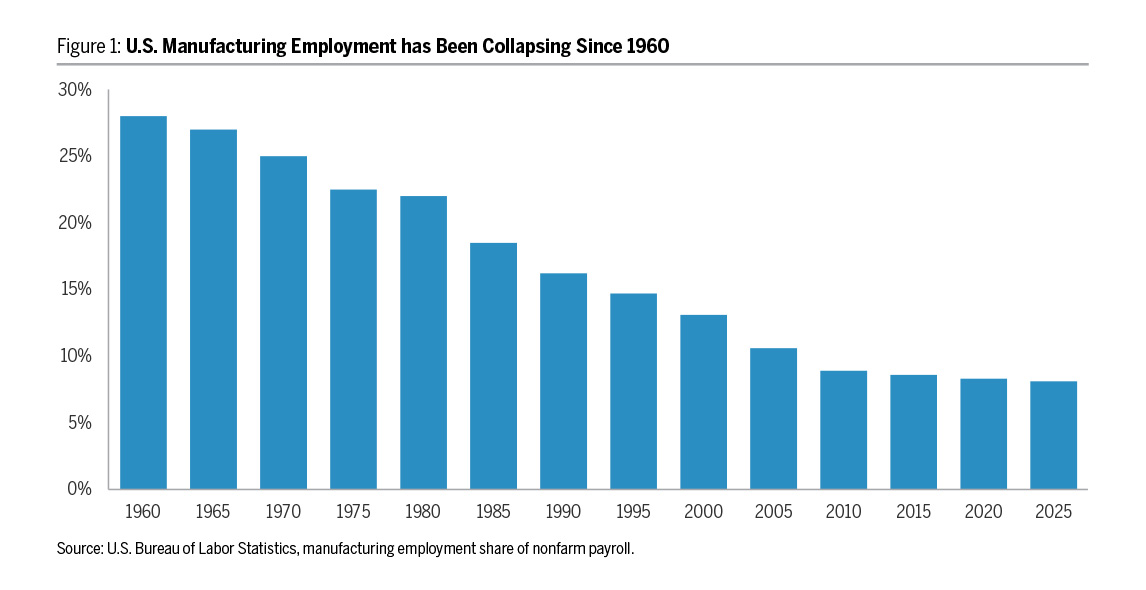
Offshoring delivered real benefits to U.S. consumers by helping to keep the price of goods low even as wages rose. The trade-off was a decline in domestic manufacturing capacity, greater reliance on overseas production, and more exposure to supply-chain disruption. For decades, that trade-off made sense because the cost of offshore labor was simply too cheap to ignore.
The Economics of a Humanoid
Humanoids are AI-enabled robots designed to work in environments built for people. The economics of humanoids may be easiest to understand on an hourly basis.
A company spends roughly $50,000 to $90,000 per year on salary and benefits for a U.S. factory worker, depending on their specialization. This equates to approximately $29 to $53 per hour for 1,700 productive hours of work.
Leasing a humanoid today costs a company roughly $100,000 per year. At today’s utilization levels, this breaks down to approximately $29 per hour for roughly 3,500 hours of work. In other words, the humanoid is already on par with a nonspecialized worker on an hourly basis, and we expect the gap to widen (see Figure 2).
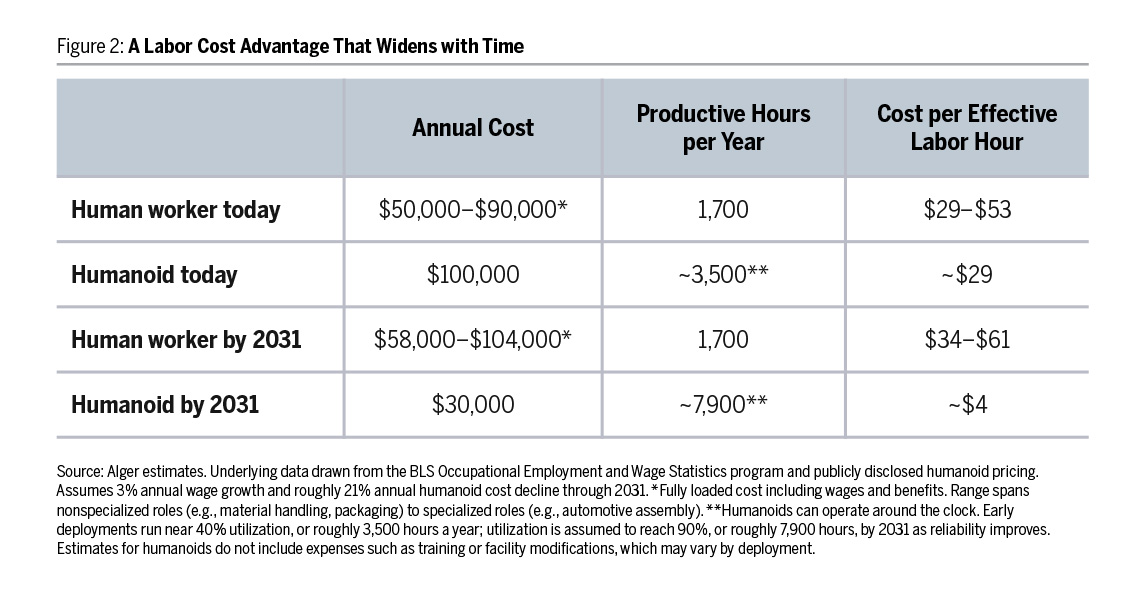
Over the next five years, wages are expected to rise with inflation while humanoid costs are anticipated to fall as manufacturing scales, hardware improves, and software increases capabilities. Based on our estimates, annual humanoid cost could drop toward $30,000 as the cost of a specialized worker approaches $104,000 by 2031. Because a humanoid can also work more hours each year, we estimate that it could have an approximately 8-to-15-times cost advantage per effective labor hour by 2031, depending on the role’s level of specialization.
Importantly, we believe this conclusion still holds under more conservative assumptions. If a humanoid delivers only 5,000 useful hours after charging, maintenance, and downtime, and if its annual cost falls only to $40,000 in 2031, it would still cost about $8 per hour versus as much as $61 for a specialized worker. The advantage appears large enough to remain meaningful even if adoption is slower or utilization is lower than expected.
Why Automation Could Bring Production Closer to Home
We believe humanoids will help change the economics of production, but they are not exclusive to American factories. An offshore plant can buy the same humanoid. The thesis is not that robots are uniquely inexpensive in the U.S. The more important point is that automation could reduce the importance of labor costs in deciding where goods are produced.
Labor has been the one factor where the U.S. has faced the clearest structural disadvantage. High labor costs have outweighed the country’s strengths, including abundant energy, deep capital markets, reliable logistics, political stability, and proximity to the world’s largest consumer market. If humanoids can perform physical work at a fraction of the cost anywhere in the world, labor becomes less important in the decision of where production should take place.
Domestic production shortens lead times and lowers inventory-carrying costs. Also, it reduces exposure to tariffs, port disruptions, currency swings, and geopolitical choke points across Taiwan, the Strait of Hormuz, and the South China Sea. A choice that was rational when offshore labor was dramatically cheaper becomes far less compelling once the labor-cost gap closes.
Where Are Humanoids Today?
A common question is whether these machines can actually do the job today, or whether they are still mostly demonstrations. The answer is that it depends on the task because the real world is messy. A factory floor, warehouse, or stockroom does not look exactly the same from one hour to the next. Parts arrive slightly out of position, a pallet is wrapped differently, or a walkway is half blocked. People adapt to these changes constantly and barely notice. Machines historically could not. Industrial robots have repeated precise motions for decades, but only when every part arrives in the same place, in the same orientation, every time.
Today’s humanoids are increasingly capable of structured, repetitive work such as moving materials, picking up and placing objects, and tending machines on the factory floor. They are also improving quickly in dexterity, perception, and the ability to handle related tasks. What is new is not repetition but context. For the first time, the artificial intelligence guiding the machine understands the physical world around it, not just the motion it was programmed to repeat.
Consider a familiar task: stacking boxes in the back room of a store. No two deliveries are alike. Boxes arrive in different sizes and weights, and some are dented or oddly shaped. Deciding where each box should go so the stack holds requires judgment. Set a heavy box on a crushed one and the pile tips.
A person makes that call instinctively. Traditional automation struggles because the task is never exactly the same. Humanoids are beginning to handle work like this, adjusting to boxes, shelves, and rooms they have not seen before. The ability to walk into an unfamiliar environment and figure out the task, rather than repeat a preprogrammed motion, is what separates this generation of machines from the last.
What still needs to be proven is reliability in unstructured settings, uptime, and the breadth of activities that a humanoid is capable of performing. The thesis rests on two assumptions: costs decline and utilization rises. The direction is clear, but timing is the key variable.
The Investment Opportunity
As with prior technology shifts, we believe much of the value may not accrue to the most visible companies, but across the enabling ecosystem, especially to companies providing scarce, mission-critical inputs for automating physical work. For investors, the opportunity can be viewed across several layers:
-
Intelligence — AI compute and models designed for physical AI and on-device, real-time inference at the edge
-
Perception and sensing — machine vision, depth, and lidar, plus tactile and force sensing that lets a robot feel as well as see
-
Actuation and motion — motors, actuators, precision gearing, and drive systems that turn intelligence into controlled movement
-
Power and thermal — batteries, power electronics, and thermal management that determine how long and how hard a humanoid can work
-
Integration and the build-out — systems integrators, automation specialists, and the factory, power, logistics, and software infrastructure required to deploy humanoids on production floors
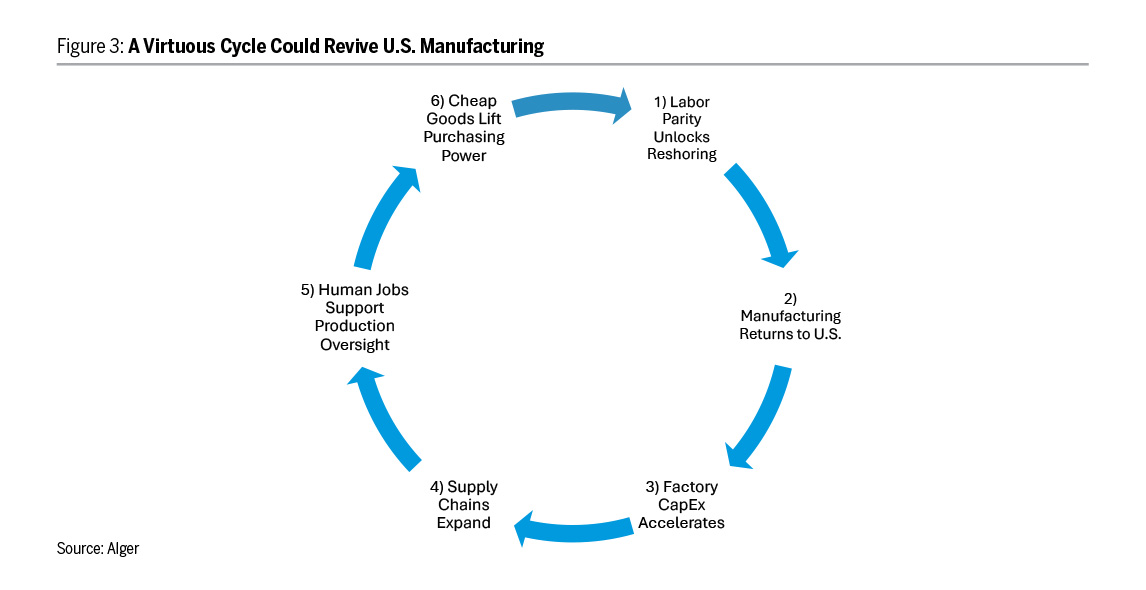
Reshoring is not a one-for-one swap of robots for jobs. Building automated capacity demands investment in facilities, equipment, software, power, and logistics. As shown in Figure 3, we believe this investment could create a reinforcing cycle of expanding domestic production, supply-chain investment, and job creation. In a scenario where the U.S. reshored roughly half of imported goods over a decade, the required capital investment could exceed $2 trillion.
1 That spending could ripple through components, maintenance, integration, and downstream support, while creating human roles in engineering, installation, oversight, and quality control. The composition of manufacturing work changes, and the demand for capital and skilled labor around it may expand.
What We're Watching
While we are optimistic about the opportunity, several risks could affect how quickly it develops. Humanoids still need to prove they can work reliably and continuously in real factories, not just in demonstrations. The build-out will require a meaningful investment, which depends in part on supportive capital markets. Safety rules, liability concerns, and regulation may add costs as robots work more closely with people. Importantly, falling humanoid costs could help the companies that use them but may pressure some robot manufacturers. If workers are visibly displaced, political or labor pushback could change the economics.
The Industrial Renaissance
At Alger, we look for positive dynamic change. We have written before
about the declining cost to create — how AI lowers the cost of producing software, content, and other digital goods. This is the physical counterpart. AI is now beginning to reshape physical production by closing the labor-cost advantage that drove decades of offshoring. These are two parts of the same transformation: the economics of digital creation and physical production are both being rewritten, along with where value is created across the U.S. economy.
That is what we believe an industrial renaissance looks like in practice: a meaningful share of offshore production returning home, built on automated capacity rather than cheap labor. That shift could fuel a multi-trillion-dollar investment cycle and contribute to a more productive, resilient industrial base. We believe the shift is structural, not cyclical, and that it could define one of the more important opportunity sets for investors over the next decade.